
Commercial Property. Explained. | A CBRE Private Wealth series
By Ingrid Filmer
Senior Managing Director, Capital Markets – Private Wealth, CBRE
Buying commercial property at auction can be an exciting step towards building an investment portfolio. It can also be a remarkably clear process: you investigate the property, organise your funding, decide your limit and compete through visible bidding.
For first-time commercial property investors, that clarity matters. You can hear the price, follow the competition and make your own decision about whether to bid again.
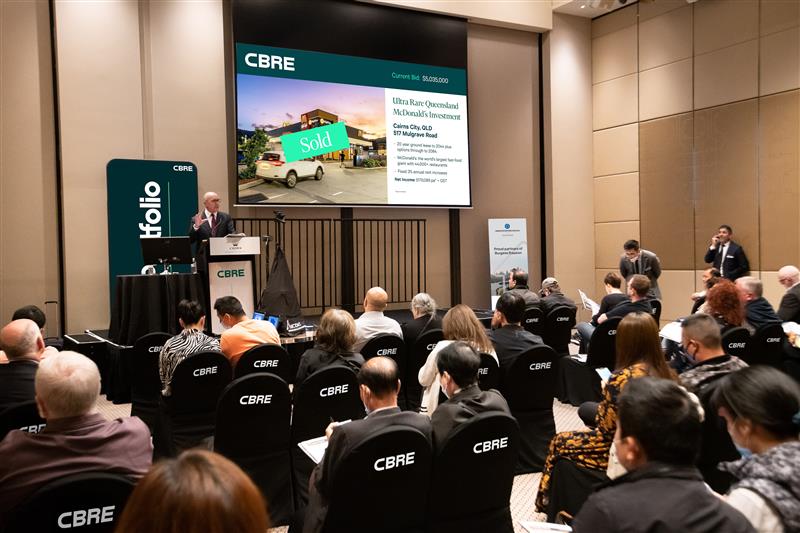
CBRE Portfolio Auctions add another valuable dimension. By bringing multiple commercial investments into one program, they give buyers an opportunity to compare properties, explore different sectors and watch the market respond.
With preparation, a commercial property auction becomes more than an event. It becomes a practical way to understand value and buy with confidence.
Why commercial property auctions offer transparency
One of the strongest attractions of auction is that price competition happens openly.
The auctioneer calls the bids and participants can follow the current price. Rather than trying to work out what another buyer might have offered privately, you can respond to the bidding as it unfolds.
That visibility helps remove some of the uncertainty from buying commercial property. You remain in control of your next bid and can stop when the price exceeds your assessment of value.
Transparency does not mean every buyer has the same budget, advice or negotiated contract arrangements. Any changes you require should be agreed and documented before bidding. Buyers should also understand the applicable auction rules, including any permitted vendor bids.
The benefit is straightforward: the bidding provides a visible test of what participating buyers are prepared to pay.
CBRE Portfolio Auctions a litmus test of the market
A single auction provides information about one investment. A portfolio auction creates an opportunity to put that result into a broader context.
Within a CBRE Portfolio Auction collection, buyers can explore different locations, tenants, lease lengths and income profiles. Each property is offered individually, so you can focus on the investment that suits your budget and objectives.
Watching several assets trade can help explain why one property attracts a sharper yield than another.
Two fast food investments might produce similar rents but have different lease terms, rental increases, land areas or locations. A childcare investment with a long lease may appeal to a different buyer from a smaller industrial property.
Comparisons are most useful when you understand those differences. Similar branding does not automatically mean equivalent investments.
Portfolio auctions offer a practical litmus test of buyer appetite and pricing across the assets offered. They provide evidence you can assess alongside comparable sales and professional advice.
The advantage of a platform built around commercial investment
CBRE’s portfolio auction platform brings together commercial investment opportunities, campaign information and agents who can explain the properties being offered.
For buyers, the value is being able to explore alternatives within a coordinated program. You can compare investments across sectors and locations, ask questions and build a clearer picture of what suits you.
CBRE’s published Portfolio Collection 182 reports $3.3 billion in total sales for 2025. That transaction activity provides a substantial base of market experience, although the figure relates to total sales rather than auction sales alone.
Experience becomes useful when it helps answer specific questions: which sales are genuinely comparable, why lease structures affect value and how a particular property fits the market.
Ask the agent for the evidence behind the assessment. A well-supported explanation is far more useful than a broad claim that every property is a great investment.
Information at your fingertips
Auction confidence begins before the bidding starts.
Request the information memorandum, contract, lease and access to the available due diligence documents. Share them with your solicitor, accountant and finance adviser early enough to investigate questions properly.
Read the lease as well as the marketing material. Confirm the legal tenant, annual rent, expiry date, options, rent reviews and security arrangements.
Understand which outgoings the tenant pays and which remain with the landlord. Check maintenance, repairs and replacement obligations, together with any applicable leasing legislation.
The tenant’s name is part of the story. The land, building, location and potential future uses also matter.
A clear information pack makes the investigation easier, but you and your advisers still need to assess the documents. If information is missing or unclear, ask for it before auction day.
Get your contract ready before auction
Have your solicitor review the contract well before the auction.
If you want a different settlement period, deposit arrangement or other amendment, raise it early through the selling agent. The vendor may agree, but do not assume a request has been accepted until the agreed arrangement is properly documented.
Commercial property auction purchases are generally intended to proceed unconditionally. Your solicitor should confirm exactly what obligations you will assume and when they become binding under the relevant rules and contract.
Do not plan to win first and negotiate protections afterwards.
Ask your advisers to explain the GST treatment too. Where a sale is intended to qualify as a GST-free going concern, understand the requirements and your responsibilities before signing.
Preparation gives you the chance to resolve practical issues while there is time to do so.
Decide who is buying including any nomination
Confirm your purchasing entity before the auction.
You might be buying personally, through a company or trust, or within a self-managed superannuation fund. Each structure needs appropriate legal, tax and finance advice.
If you intend to use “and/or nominee’, discuss it with your solicitor beforehand. Those words do not provide an automatic right to change the purchaser without contractual or tax consequences.
Nomination rules vary by jurisdiction. In Victoria, the State Revenue Office explains that the sub-sale provisions can result in additional duty, including where relevant land development occurs before nomination.
Make sure the entity, signing authority, funding and any intended nomination work together. If someone will bid for you, arrange the required authority in advance.
Sorting this out early helps keep the purchase moving smoothly after the auction.
Organise finance and an accessible deposit
Speak with your lender or commercial finance broker early.
A general pre-approval or borrowing indication may still depend on the property, valuation and other lending conditions. Understand what remains outstanding and whether you can meet your purchase obligations.
Confirm the contract deposit, payment deadline and accepted payment method with the agent. Check transfer limits and ensure your funds will be available.
The auction deposit is only part of the money you need. Allow for your total equity contribution, applicable duty, legal fees, finance costs, settlement adjustments and any GST funding requirement.
Keep a sensible cash buffer for ownership as well.
Knowing your funding position allows you to concentrate on the investment rather than solving banking problems during the auction.
Set a purchase limit that works for you
Decide your maximum price before bidding begins.
Base it on the property’s income, lease, location, comparable evidence and your investment goals. Include acquisition costs and the impact of borrowing.
For illustration, annual net rent of $100,000 represents a passing yield of 5% at a $2 million purchase price. At $2.1 million, the yield falls to approximately 4.76%, before acquisition costs and finance.
That additional bid may still make sense for you. The point is to understand what it changes.
Your limit should reflect your own assessment, rather than the enthusiasm of another bidder. Different investors have different funding, objectives and views of future value.
A considered limit lets you participate confidently and recognise when an opportunity has moved beyond your budget.
How to bid at a commercial property auction
Confirm the available bidding methods for your chosen property with the agent. If you plan to participate remotely, organise the arrangements and any required registration ahead of time.
Check the auction time, time zone, lot order and identification requirements. If bidding online, familiarise yourself with the platform. If bidding by telephone, confirm the contact arrangements.
During the auction, listen carefully and make your bid clearly. Ask the auctioneer to clarify the current price if necessary.
There is no bidding technique that guarantees success. Being prepared, visible and decisive is more useful than trying to predict every other participant.
If the investment suits you and remains within your limit, be ready to act.
After the auction and before your next one
If successful, follow the contract signing and deposit process required for the sale. Your solicitor can then coordinate settlement, while you finalise finance, insurance and property management arrangements.
If a property is passed in, there may be an opportunity to negotiate through the agent. Ask how the process will work rather than assuming a particular negotiating right.
You can also attend a portfolio auction without buying. Observing several properties is a valuable way to become familiar with pricing and the process before making your first purchase.
Explore the CBRE Portfolio Auction collection, identify investments that suit you and start the conversation early.
For broader guidance on leases, yields and due diligence, read the Demystifying Commercial Property guide alongside this article. With the groundwork complete, auction day becomes an opportunity to put informed decisions into action.
Commercial property does not need to feel too hard. Follow the series and let’s demystify it together.